
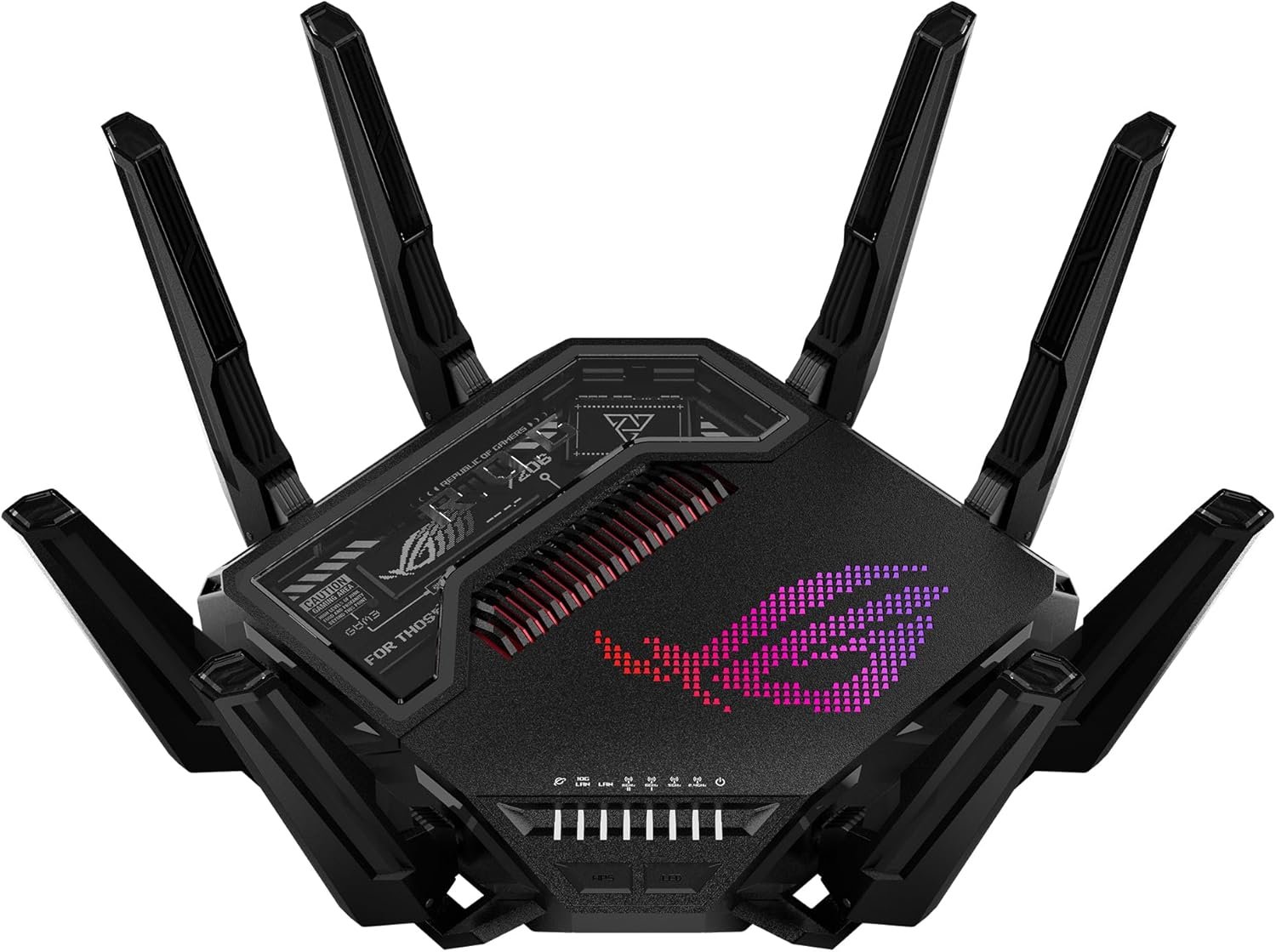
ASUS ROG Rapture GT-BE98 PRO First Quad-Band WiFi 7 Gaming Router supports 320MHz, Dual 10G Port, Triple-level Game Acceleration, Mobile Game Mode, Subscription-Free Security, AiMesh, and VPN features
$84.99
Related Products





The ASUS ROG Rapture GT-BE98 Pro quad-band WiFi 7 Gaming router is beyond fast. With dual 6 GHz bands, dual 10Gbps ports, and new WiFi7 technlogies such as Multi-link Operation, achieve speeds of up-to 30Gbps and push the boundaries of whats possible in networking. Disclaimer: Actual data throughput and WiFi coverage will vary from network conditions and environmental factors, including the volume of network traffic, building material and construction, and network overhead, result in lower actual data throughput and wireless coverage.
Beyond-fast WiFi 7 (802.11be) with new 320MHz channels in the 6 GHz band and 4096-QAM significantly increases network capacity and throughput, with speeds of up to 30 Gbps
Multi-link Operation links to multiple bands at the same time to ensure stable internet connections and efficient data transfers
Cutting-edge external dual-feeding antennas boost coverage by providing high efficiency and significantly enhanced signal strength
Maximized wired connectivity and flexibility with dual 10G ports and quad 2.5G ports
Triple-Level Game Acceleration – The GT-BE98 Pro boosts your PC gaming traffic every step of the way, from your PC gaming port all the way to the game server.
9 reviews for ASUS ROG Rapture GT-BE98 PRO First Quad-Band WiFi 7 Gaming Router supports 320MHz, Dual 10G Port, Triple-level Game Acceleration, Mobile Game Mode, Subscription-Free Security, AiMesh, and VPN features
Add a review

$84.99
T. Chardis –
Initially buggy, … but board and firmware revisions now equal a winner
Too Long Don’t Wish to Read – The ASUS ROG Rapture GT-BE98 Pro (hereafter noted as the “98 Pro”) (released in March of 2024) takes the underwear of other Wifi 7 flagship routers and pulls them up over their heads and then slaps em silly. Although initially buggy with incomplete functions, … new motherboard versions (Hardware Version 3.0 {also known as 1.2a}, released in February of 2025) combined with firmware updates (versions 37812 {March}, 37839 {May}, 37849 {July}, 38984 {August}, and 39112 {October}) have slowly transformed this router from a three-star device into the more mature product that was promised by ASUS back in early 2024. Five stars as of November, 2025.The long version – Few people are going to be able to afford the GT-BE98 Pro, … much less set it up correctly, … but for those who can, this router can perform some fairly rare functions while using the very latest standards. Initial versions (models sold until November of 2024) of the BE98 came with the slightly buggy Hardware Version 1.0 motherboard and suffered from a few half-baked functions in the firmware. In many ways, those initial 98 Pro’s were inferior to the prior ROG Rapture GT-AXE16000 and GT-AXE11000 routers, especially when it came to Wifi 6 and 6E clients. As of February, 2025, ASUS is currently on their third motherboard revision (Hardware Version 3.0 {also known as 1.2a}) and updated the firmware on October 29th, 2025 to 3.0.0.6.102_39112 (for United States owners). This latest board version and past several firmware versions have hammered out most of the bugs, nags, and missing features that plagued most of 2024. Let’s look at some of the current features:Build Quality – Although the initial motherboards had some small bugs (these router boards are noted as “Hardware Version 1.0” on the underside of the router and were released in March 2024), some problems were ironed out with Hardware Version 2.0 (which were released in November, 2024) (these boards are also noted as 1.1). The 98 Pro finally reached a more mature state in February of 2025 with the release of the Hardware Version 3.0 boards (1.2a). Firmware updates will work on all the boards, so no worries about needing separate versions. Due to the 2.6 GHz quad-core processor and the amount of clients it can handle, heat release is paramount to the 98 Pro’s design. Mine, sitting about two feet off the ground (see pic) in an open space gets slightly warm but never hot (the CPU typically runs at about 42 deg C). Also, … the eight antennae feature two internal dipole elements each and need to be extended (per the user manual) for the best throughput. The 98 Pro also features separate amplifiers for each radio chain (and this is what helps it to saturate a large home for example). The 98 Pro also features two 10G ports and four 2.5G ports on the back, … in short, you are covered for the latest fiber optic speeds up to 10G. (The more technically inclined here may wonder how does a 2.6 GHz CPU process 10 Gbit/sec of incoming data. The answer in part is that the router uses ASIC {Application Specific Integrated Circuits} for forwarding combined with packet processing offload. {electrical engineer here, … you’re in good hands}) Finally, the 98 Pro is covered in LEDs and Aura lighting, which can all be controlled through the web interface. The styling is, … well, … let’s call the design, … spiderbot. Some will love it and some will hate it. I don’t mind the styling but I wish they had removed the stickers from the clear window portion and expanded that area with more heatsinks for the CPU. Overall, the build quality is exactly what you would expect from such a high-end router. Please be aware that this router is sold as the GT-BE98 without the “Pro” designation in Canada and Europe due to those countries’ respective regulations concerning the 6 GHz bands (other than that, the two routers are identical).Initial Setup – A new owner has the option to either use ASUS’s smartphone Router app (which I don’t recommend due to security concerns) or the far better web interface (usually reached by typing 192.168.50.1 into your address bar). The start up procedure will ask the owner a bunch of simple questions to set up your password, Smart Connect and/or separate SSIDs, mesh networking, and so on. It only takes a few minutes but works well. The one thing I do not like is that you cannot setup the router until you have internet access. The 98 Pro really needs the ability to be accessed for troubleshooting even if the internet is down (id est, … particularly when the internet is down).Firmware Features – In short, the 98 Pro is stacked with just about every possible feature a home user could want or need. Smart Connect is configured stock and works very well for those who don’t want separate SSIDs. The 98 Pro will support up to 32 separate networks (and SSIDs) for those that need it. I, myself, have my 98 Pro set up with a separate SSID for each band (2.4 GHz, 5 GHz, 6 GHz (1), and 6 GHz (2)) along with a separate network for guests (aptly named, “Alien_Anal_Probe_for_Guests”) and a separate network for IoT devices (security cams, etc …). The 98 Pro also supports Multiple-Link Operation (MLO) networks which combine the 2.4 GHz and 5 GHz and 6 GHz bands together, which also works well as of November, 2024. Since March of 2024, there have been about eleven firmware updates for the 98 Pro, but I do wish that they would release firmware updates about once a month though to keep everything fully current.Protection – The 98 Pro also offers the usual firewall services (iPv4, iPv6, etc …), NAT, etc … tools but also offers Trend Micro’s AI Protection free of subscription fees. While it won’t stop everything, the service is a nice extra add-on for a home user. ASUS also offers ADGuard DNS through its firmware under the parental controls section (also a free subscription although you have to sign up for it). I have been testing it and so far have found it does indeed cut down on sites that try to blind you with 40 ads popping up. The downside is that the free ADGuard only protects against so many ads per month (and of course, they then want you to go to their site and sign up for one of their paid versions). The 98 Pro also supports fairly extensive Parental Controls. If you have little ones in the house and don’t want them headed to websites that rhyme with “hub,” it is fairly easy to set that up with this router.Gaming Features – True to its Republic of Gamers (ROG) moniker, the 98 Pro provides several services to help out online gamers. The Game Booster page offers three levels of Quality of Service (QOS) adjustments and there are separate settings for managing ping to well known game servers (Call of Duty, War Thunder, Arma, Eve Online, etc ….). The end user also has numerous customizable options for tailoring any game connection to their liking and there is even the ability for the router to recognize other ROG devices (like motherboards). I use the Game Booster features for DCS World online flight simming combat and have brought my average ping down from about 14 milliseconds to about 12 milliseconds for the two preferred servers I enjoy playing on. Nothing Earth shattering, … but any boost I can get is welcome. I will say that I think ASUS ROG routers in general do a better job of ping optimization than any other brand currently on the market.WiFi 7 – The IEEE introduced Wifi 7, also known as 802.11be back in January of 2024. From a technical standpoint, Wifi 7 offers MLO, MIMO, Flexible Channel, and MRU improvements to Wifi 6 and 6E standards. The Wifi Alliance states that Wifi 7 allows up to 23 Gbits per second but that is purely theoretical. In the real-world, Wifi 7 using the 98 Pro will realistically reach around 4 Gbit/sec (with 2×2, 320 MHz) while the prior Wifi 6E (with 2×2, 160 MHz) reaches about 1.7 Gbit/sec. The 98 Pro can also utilize 8×8 connections at 320 Hz but I have yet to see any clients on the market offered with that hardware. While the Wifi Alliance promises Wifi 7 speeds out to 98 feet indoors, realistically you are looking at more like 15 to 25 feet, … so you need to be in the same room with no walls blocking the signal. Truth be told, … Wifi 7 is really a bit of a short range gimmick. That said, does the 98 Pro fulfill Wifi 7 speeds? … Yes, as of November, 2024, it can indeed reach these speeds as long as the client is less than 25 feet from the router. As of Hardware Version 3.0 (1.2a) (starting mid-Feb, 2025) and the latest firmware versions (37849 {July}, 38984 {August}, or 39112 {October}) .. excellent. My Pixel 9 Pro XL and my wife’s iPhone 16 both work excellently (both have sadly been handicapped with only 2×2, 160 MHz MIMO configurations {hardware limitation of their Wifi chips}) although only within the same room and only out to about 8 meters or so. Testing some file transfers (with iperf 3), I was able to reach speeds of 2000 Mbps from 3 feet away and 1700 Mbps from 15 feet away, … smoking fast! Am I ever going to need file transfers that fast? …. Not really, … but it is nice to have.Wifi 6 and 6E – As noted previously, … initially the 98 Pro performed poorly compared to dedicated Wifi 6E routers like the GT-AXE16000. Much of these problems were ironed out (finally) from Nov to Jan of 2025. The 98 Pro now delivers full Wifi 6 and 6E throughput if the client supports those standards. I use a Meta Quest Pro VR headset (which uses Wifi 6E at 2×2, 160 MHz but not Wifi 7) in wireless mode to fly virtual aircraft in MSFS 2024/2020, DCS World, and IL2 (I have my first 6 GHz band setup exclusively for the Quest Pro headset so there is no interference). I have tested the Quest Pro with numerous routers and the 98 Pro now exceeds the GT-AXE11000 as the best router I have ever used for connecting the headset, If I connect by way of the Meta Air Link protocol, I often reach speeds of 225 Mbps using the H.265 (HEVC) codec. If I use the alternative Virtual Desktop and the H.264 codec, I often reach speeds of about 1300 Mbps from three meters. My dream of flying in high fidelity and with all settings maxed in DCS World without a Meta Quest Link cable has finally been realized.Wifi 5 and 2.4 GHz – So far, excellent. The 98 Pro has the highest speeds I have ever seen on the 5 GHz band at roughly 1100 Mbps (from 25 feet) (upstairs and through three walls I am getting roughly 740 Mbps). (To measure this correctly, you need to do so with iperf 3 and professional packet transfer tools. You can’t measure this with Speedtest or Wifi Analyzer.) With the 2.4 GHz band, I am getting excellent penetration throughout the house (about 129 Mbps at three meters and 23 Mbps at 30 meters) and all of my 23 IoT devices can connect without problems or delays, even cameras 95 feet away on my back fence.Network Attached Storage – The 98 Pro features one 3.2 USB port and one 2.0 USB port. I have my 2TB Samsung T9 SSD attached to the USB 3.2 port and am getting file transfer speeds around 1750 Mbps! I did briefly try out ASUS’s AICloud feature but it seemed half-baked and more of a security risk, so I turned that feature off. I have never tried their Samba setup, so can’t comment there.Custom Firmware – The 98 Pro is compatible with the WRT Merlin custom firmware releases which give the router some additional features not found in the stock firmware. It is also nice to be able to use this firmware if you find a feature in the stock firmware is not working as well as you wished. Sadly, the 98 Pro cannot use DD-WRT custom firmware at this point in time.Conclusion – Anytime the IEEE releases a new Wifi standard, it is always going to take a few years for real-world products to actually fully implement those standards. The 98 Pro is no different. When the 98 Pro was first released in March of 2024, it was somewhat buggy and had numerous small issues with both Wifi 7 and 6E connectivity. In short, … it was a three star router. It reached a four star router level around Dec of 2024. Now that there have been two motherboard changes and several firmware releases, the 98 Pro is indeed reaching true Wifi 7 speeds and has fixed most of the small bugs and 6E connectivity issues that plagued it in 2024. Overall, it is now a five star product.
Jay Ryder –
ASUS ROG Rapture GT-BE98 PRO — Lightning Fast and Built to Last
The ASUS ROG Rapture GT-BE98 PRO has been performing brilliantly. It delivers blazing-fast speeds, rock-solid stability, and I’ve had zero disconnects since setting it up. Everything from streaming to gaming feels incredibly responsive. It’s clearly designed with the future in mind — WiFi 7, multi-gig ports, and tons of advanced features make it more than ready for years of use. It’s not cheap, but the performance and reliability make it worth every penny. This is one of those “buy once and forget about upgrades for a long time” kind of routers.
Tennessee Jed –
Worth Every Penny: The Only Router You Need for Next-Gen Gaming
I finally pulled the trigger and upgraded to the ASUS ROG Rapture GT-BE98 PRO, and let me tell you, this thing is an absolute beast. If you’re a serious gamer, a streamer, or just have a house full of smart devices hogging bandwidth, stop looking—this is your endgame router. The jump from my old Wi-Fi 6 unit to this Wi-Fi 7 monster is truly night and day.This router is a premium investment, but it’s one of those purchases you won’t regret. It truly future-proofs your home network for the next generation of gaming and high-speed internet. If you want the fastest, most stable network performance available right now, just buy the GT-BE98 PRO. Highest recommendation from a dedicated enthusiast!
Jonny –
Atrocious Dual Wan Support
_ TL;DR _Don’t purchase for dual WAN._ BACKGROUND _I’m a web developer and semi-casual gamer with a background in SaaS and hardware tech support. I’m not a ‘networking guy’ but know enough to educate myself and troubleshoot that which I don’t know._ WHY I BOUGHT IT _My wife and I both work from home and rely on high-speed internet connectivity. We get Spectrum internet for free through our HOA but my career requires much faster upload speed than Spectrum’s abysmal offerings so we subscribe to Frontier’s 5Gig plan.I wanted a dual WAN router that would allow me to use both ISPs—Frontier for our primary connection, then fail over to Spectrum in the extremely rare event that Frontier experiences an outage. Additionally, I was looking for a router with USB 3.0 support so I could plug in my hard drive (used only for hourly backups). The ASUS GT-AXE16000 seemed to meet that need . . . on paper at least; so I bought it._ PROS _1) Excellent 2.4Ghz rangeI have a 2-story home with several smart devices scattered throughout the inside and outside of the home. The WiFi range is so good it negates the need for a couple mesh TP-Link WiFi extenders that I had purchased just to ensure that the smart devices furthers away from my ISP’s router have a solid connection.2) FeaturesThe GT-AXE16000 is incredibly feature-rich; shame that the ones I want to use aren’t reliable or flat out don’t work at all.3) Prioritization for GamersThis is actually pretty cool. There are a few different options to ensure that individual games or devices get bandwidth priority and will auto-apply NAT settings for you. Very sexy features for gamers or in my case gamer wannabes._ PROBLEMS _1) Dual Wan SupportNon-existent. Whether I’m in Fail Over mode or Load Balance mode, the secondary WAN will return one of several errors.1.1) ” Your ISP’s DHCP does not function properly”Whichever ISP/modem is set to the Primary WAN works fine and whichever ISP/modem is set to the Secondary WAN will return this error.1.2) “Network cable unplugged”Nope, definitely not. In purchasing this router I also purchased several CAT8 cables. I’ve tested them all with other devices and they work just fine. But this god-forsaken router wants to tell me a cable is unplugged? I think I know how to check if a cable is seated properly. This error only occurs on which WAN is set to Secondary.Update 20251024: Um, so dual WAN works now. I changed zero settings. It just started working and the secondary WAN is on Hot Standby just as it should be.3) “No disk detected”Okay so this thing will recognize that a disk is connected, but will not mount the disk which means I can’t use the Time Machine feature. Part of the reason I bought this was to use my existing bus-powered drive to connect directly to the router rather than having to purchase a NAS device.Update 20251024: Figure out why I couldn’t get this feature to work. The router will not mount APFS formatted drives. So if you’re a Mac user and your OS is anything later than macOS Sierra (10.12.4), which was released in 2016 by the way, you will not be able to mount your storage.4) Guest Network InstabilityNot kidding, the guest network will just disappear sometimes. Other times the SSID is visible but has no internet connectivity. Sometimes, rebooting will fix it, sometimes it won’t Sometimes changing the [insert random] setting will fix it, sometimes not. Completely unreliable.Update 20251024: Okay this one is on me. The Guest Network feature has a scheduling feature. I mistakenly misunderstood how this feature works in thinking that once a device connects to the Guest Network, that device would be removed after the schedule. Instead, the schedule feature affects the duration of Guest Network uptime, so once the schedule is complete, the Guest Network will just shut off. I’ve since disabled the scheduling feature and the Guest Network works just fine. My mistake.5) UI/UXThis one is debatable, but to me the user interface and experience is pretty terrible. All of the red hues are abrasive and reminds me of a poor layout of a MySpace profile made by some emo kid that thought they were a hacker because they copied and pasted some Javascript. It’s bad. The verbiage used in the admin interface is broken english at best. If grammatical and punctuation errors were a virus, this interface has been severely infected. Not to mention some of the verbiage is flat out wrong. Example: “When the Primary WAN is detected to have an active internet connection using a physical cable for X continuous times, failback to the Primary WAN.” The last “Primary WAN” should actually read, “Secondary WAN” as the associated tooltip describes as follows: “The time period criteria to trigger failback mechanism.When you change to the secondary WAN, the router will check how long primary WAN is connected. If the primary WAN connection is stable (longer than failback detect time), the connection will change to primary WAN.”_ TROUBLESHOOTING _When in doubt reboot, right? Yeah that doesn’t do a f*****g thing other than bring up some new problem. Hours of troubleshooting have led me to switching the ports my modems are plugged into, changing the “DHCP query frequency” setting to “Aggressive”, “Continuous”, and “Normal”. I’ve cloned the MAC Address. Tried manual, static, and dynamic IPs . . . the list goes on. In the past 2 weeks, I’ve tried every single solution I could find from ASUS support docs and beyond. I’ve every support article from ASUS I could find for every issue I’ve encountered; none of their ‘fixes’ actually fix anything. This led me down a deep search for help outside of ASUS, what has worked for others has not worked for me (at least consistently)._ FINAL THOUGHTS _I am not the only person that has experienced the above issues and the issues persist for myself and many other owners of the GT-AXE16000. Heck, even AIO’s will tell you that ASUS is notorious for Dual WAN/DHCP issues. I wish I did more research before purchasing this. I’ll be returning it as soon as I find a reliable replacement.
Abdullah –
كاتبين راوتر و اصحاب القنوات في اليوتيوب كاتبين راوتر وهي في الاخير موزع انترنت وليس راوتر يعني ما تركب فيه شريحة اصلا
hmoud –
ممتاز الاشارة تعطي المكان باكملة منتج عالي الجودة متوقع من شركة اسوس
Balsha –
INSANE
Alberto –
Es un router con distintas funciones, puede emplearse en modo bridge sin problema o como equipoPrincipal, es algo grande y voluminoso y ninhay forma de empotrarlo en la pared a menos que hagas adaptaciones, pero no deja de ser robusto, bien contruido estético y cumple enteramente su función de optimizar laRed ya sea inalámbrica por sus distintos canales o mediante Ethernet. La aplicación de gestión podría ser más vistosa y agradable visualmente pero cumple su propósito
Jose S. –
I recommend this router for home use with more than 1gbps internet connection and other network devices that you need to communicate fast within your netwotk.All in all, this is an excellent router for multiple devices in your home🙏